


Welcome to the Neighborhood: Experiencing Kauai's Animal Locals
Kauai doesn't do wildlife behind glass. Here, you share a shoreline with creatures that have called these islands home for millions of years before any hotel, highway, or human showed up.
You'll pad out to the beach with your coffee and find a 200-pound Hawaiian monk seal sleeping on the sand 40 feet from your lanai. A green sea turtle will fin past the lava rock shelf, slow and unhurried, its shell slick with sunlight. And the roosters? They announced sunrise about an hour before you were ready for it.
Three animals define the Kauai wildlife experience: the Hawaiian green sea turtle (honu), the critically endangered Hawaiian monk seal, and the island's gloriously feral chickens. Each one lives on its own terms, and each one demands something different from us as visitors. Respect, distance, and maybe a sense of humor.
Honu: The Hawaiian Green Sea Turtle
The Hawaiian green sea turtle, or honu, is the most commonly encountered marine reptile on Kauai. Adults weigh between 200 and 350 pounds, with shells that range from olive to dark brown, often patterned with algae growth they pick up grazing on limu (seaweed) along rocky shorelines.
Honu are protected under both state and federal law. Touching, harassing, or approaching within close distance is illegal, full stop. But you won't need to get close. They aren't shy. They'll feed just feet from shore while you stand knee-deep in the water, watching.
The Rare Phenomenon of Turtle Basking (Why Hawaii Is Unique)
In almost every other ocean on Earth, green sea turtles generally only come ashore to lay eggs. That's it. The rest of their lives happen in the water.
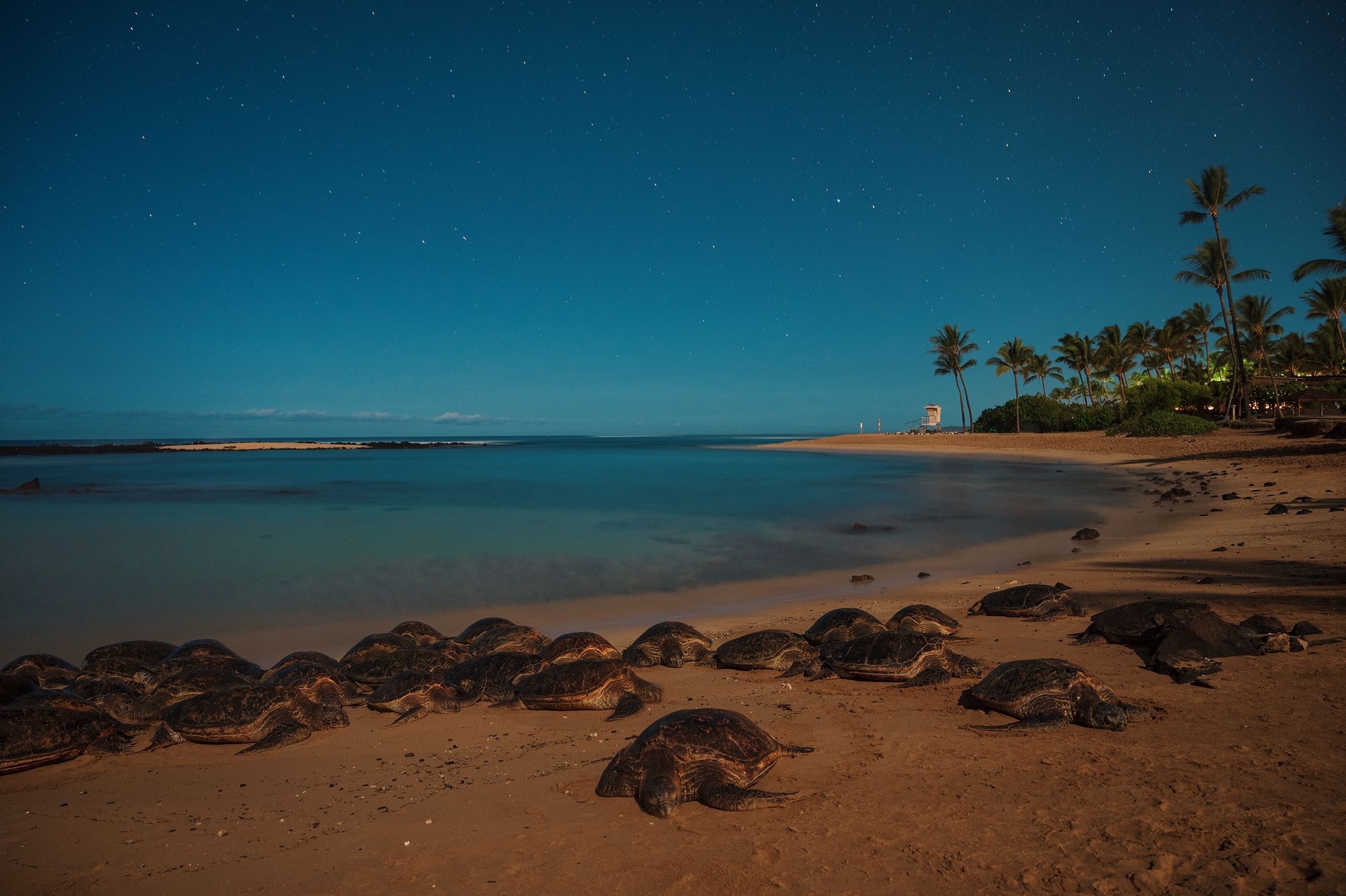
Hawaii is different. Here, honu regularly haul themselves onto the sand just to rest and warm up. Researchers call this "terrestrial basking," and it remains uncommon outside the Hawaiian archipelago. Scientists believe the behavior helps the turtles regulate body temperature, boost their immune systems, and conserve energy between foraging sessions.
The result is something you rarely see in the Galápagos, Australia or on Socorro Island: a massive sea turtle parked on a sunny beach, eyes half-closed, flippers stretched out like it booked the afternoon off. It looks almost absurdly relaxed. It is one of the most striking wildlife moments you can witness anywhere in the Pacific.
Spotting Turtles Near Kauai Shores and Poipu Beach
At Kauai Shores Hotel, turtles appear most often in the water. Guests spot honu swimming and feeding along the rocky nearshore areas, sometimes just 15 or 20 feet out. Early mornings and late afternoons are your best windows. Grab a chair near the shoreline and watch for the dark, rounded shape of a shell breaking the surface.
For on-land basking, head south. Poipu Beach on Kauai's South Shore is one of the most reliable spots in all of Hawaii to see honu hauled out on the sand. Turtles bask there almost daily, and volunteers typically mark the area with signs and ropes so visitors know to keep their distance. The drive from Kauai Shores to Poipu takes about 35 minutes, making it a natural half-day outing.
The Highly Endangered Hawaiian Monk Seal

The Hawaiian monk seal (Neomonachus schauinslandi) is one of the most endangered marine mammals on the planet. Fewer than 1,600 remain. They exist nowhere else. Every individual animal matters to the survival of the species.
Seeing one in the wild is not a guarantee. It's a privilege that most people never get.
Monk seals are solitary by nature. They spend days at sea hunting fish, eels, and octopus on the reef, then haul out onto beaches to sleep, sometimes for 24 hours or more. They look like oversized gray sausages with enormous dark eyes and a calm, almost meditative stillness. When they rest, they rest completely.
Napping on the Sand at Kauai Shores Hotel
This is one of those things that surprises guests every single time: Hawaiian monk seals haul out onto the beach directly in front of Kauai Shores Hotel.
It doesn't happen every day. But it happens often enough that staff and local volunteers know the drill. When a seal shows up, a perimeter goes up: ropes, signs, and sometimes a volunteer stationed nearby to answer questions and keep well-meaning visitors from wandering too close.
The rule is simple. Stay at least 50 feet back. No exceptions. No "just one photo from a little closer." These animals are protected by the Endangered Species Act and the Marine Mammal Protection Act, and fines for harassment can be as high as $50,000.
From 50 feet, though? You'll see everything. The slow rise and fall of their breathing. The way they occasionally lift their heads, blink at the ocean, and go right back to sleep. It is a quiet, grounding moment, the kind of encounter that stays with you longer than any zipline or helicopter tour.
You don't have to drive anywhere or book a guided excursion. You just walk outside.
The Unofficial Mascots: Kauai's Wild Chickens
No guide to Kauai wildlife is complete without the chickens. And yes, "wildlife" is the right word.
Kauai's feral chickens, descendants of Polynesian jungle fowl (moa) and domestic birds released when Hurricane Iniki destroyed coops across the island in 1992, roam free everywhere. Beaches. Restaurant patios. Hotel lobbies. Gas station parking lots. They are bold, loud, and completely indifferent to your schedule.
The roosters are the real show. Iridescent green-black tails, fiery orange hackle feathers, and a crow that starts well before 5 a.m. They don't care about your sleep. They have never cared about your sleep.
But they grow on you. By day three, you'll be photographing them. By day five, you'll have a favorite. They're part of the personality of this island in a way that's impossible to manufacture, and they'll follow you from Kapaa to Kōkeʻe without any regard for altitude, terrain, or social convention.
Island Etiquette: How to Be a Responsible Wildlife Viewer
Most animals on this island are protected by either state or federal law. Kauai isn't a petting zoo. It's their home, and we're just visiting. Here's what responsible viewing looks like:
Sea turtles (honu): Maintain at least 10 feet of distance on land and in water. Never touch, chase, or block their path to the ocean. If a turtle is heading toward the water, move aside.
Monk seals: Stay behind ropes or at least 50 feet back. Do not approach, touch, or attempt to feed them. Keep dogs away. If you see a seal that appears sick, injured, or entangled, call the NOAA hotline at (888) 256-9840.
Chickens: They won't hurt you. Don't feed them. It attracts more of them and makes them aggressive around food, which creates problems for everyone.
General rules: No flash photography aimed at any resting animal. Keep voices low near seals and turtles. If an animal changes its behavior because of your presence, you are too close.
Why Kapaa Is Your Smart Wildlife Basecamp
Kapaa sits on Kauai's East Side, roughly centered between the island's famous North and South shores. That geography matters for wildlife lovers.
Head south for 35 minutes and you're at Poipu Beach watching honu bask in the sand. Drive north for about 40 minutes and you reach Kilauea Point National Wildlife Refuge, home to massive colonies of Laysan albatross, red-footed boobies, and nēnē (the Hawaiian state bird). At the hotel itself, monk seals and sea turtles show up on their own terms, no car required.
Kauai Shores Hotel sits on this exact stretch of shoreline. Your morning coffee view might include a resting seal or a turtle cruising through the surf. The retro-cool rooms face the ocean. The lava rock pool catches the afternoon light. And the beach starts at the edge of the property, no shuttle bus, no wristband.
Ready to stay somewhere that shares its shoreline with nature? Book a beachfront room at Kauai Shores Hotel, where the wildlife comes to you.
FAQs
Can you see sea turtles from Kauai Shores Hotel?
Yes. Guests regularly spot Hawaiian green sea turtles (honu) swimming and feeding in the water just offshore from the hotel. For on-land basking, Poipu Beach on the South Shore offers almost daily sightings and is about a 35-minute drive from Kapaa.
Do Hawaiian monk seals come to Kauai Shores Hotel?
They do. Monk seals periodically haul out onto the beach directly in front of the hotel to rest. When this happens, volunteers set up a perimeter. Guests must remain at least 50 feet away at all times, as monk seals are protected under the Endangered Species Act.
Why are there so many wild chickens on Kauai?
Kauai's feral chicken population exploded after Hurricane Iniki in 1992, when the storm destroyed coops across the island and released domestic birds into the wild. These birds interbred with Polynesian jungle fowl (moa) that had been on the island for centuries, producing the colorful, hardy population you see today. Kauai has no natural ground predators like mongooses, so the chickens thrive unchecked.
What should I do if I find an injured monk seal or sea turtle?
Do not approach or touch the animal. Call the NOAA Marine Wildlife Hotline at (888) 256-9840 immediately. Stay nearby at a safe distance to help direct responders to the location if possible.
Is Kapaa a good base for wildlife watching on Kauai?
Kapaa is one of the best bases on the island. The East Side location puts you within 35–40 minutes of both the South Shore (Poipu Beach for turtle basking) and the North Shore (Kilauea Point National Wildlife Refuge for seabirds). Kauai Shores Hotel adds the bonus of on-property monk seal and sea turtle sightings right from the beach.
Originally published on 5/1/2026. Last updated on 5/1/2026
